Oil in compressed air is easy to underestimate. An oil-injected compressor delivering 1,000 m³/h of free air carrying 3 mg/m³ of oil aerosol sends 24 kg of lubricant into your network over 8,000 operating hours. Coalescing filters are what stop it.
They do it well for as long as they are looked after, and their running cost is their pressure drop. Every extra bar your compressor adds to push air through a loaded element costs about 7 % more energy. Here is how to keep them clean, effective and cheap to run.
Check differential pressure every week
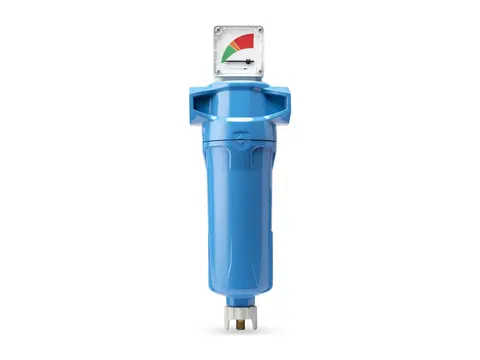
Read the differential pressure gauge weekly and write the figure down. Record the initial differential pressure at full flow when a new element goes in, as the baseline for every later reading.
- A rising trend shows the element loading with particles.
- A fall to near zero shows a ruptured element or a displaced seal, through which unfiltered air passes straight to the outlet.
Check the gauge itself against a reference annually. A stuck gauge reads a constant value while the element blocks or ruptures.
Test the drains every day
Test automatic drains daily and service them every 6–12 months, cleaning the inlet strainers at every service. A stuck drain floods the bowl, liquid reaches the element and is carried downstream. A blocked strainer stops the drain discharging even when it appears to work.
Replace elements every 12 months
Replace elements every 12 months, or sooner if differential pressure reaches the manufacturer’s limit. Solids and liquid raise the pressure drop over time, and repeated pressure changes and flow pulsations stress the fibre structure, so removal performance can decline before the gauge signals it.
- Change both stages together. A spent general-purpose element passes more liquid and dirt to the fine stage and shortens its life.
- Change elements immediately after an oil carryover event, such as a compressor separator failure. A flood of oil saturates the media, and liquid oil passes to the outlet until the element is changed.
- Fit a new head O-ring or seal every time. A hardened or damaged seal lets air bypass the media without being filtered.
- Inspect bowls, housings and threads at every change. The housing contains pressure, and corrosion or thread damage can cause a bowl to separate.
- Label each housing with its grade and the date of its last element change.
Never wash or reuse an element
Washing disturbs the fibre structure and leaves solvent residue, and the element cannot be restored to its rated efficiency. Store spare elements sealed in their packaging: exposed media collects dust and moisture that load it before it is even installed.
Look after the oil-water separator too
The oil your filters remove ends up in the condensate. Service the oil-water separator on its own schedule, because a saturated separator discharges oily condensate into the drain system and breaches local discharge limits.
Verify air quality once a year
A filter rating is not a site result. Verify air quality at critical points annually, using ISO 8573-2 for oil aerosol and ISO 8573-4 for particles. Measurement confirms the stated class is being met in your process, where audits require evidence rather than filter ratings.
Let our engineers take a look
Our compressed air quality testing measures the contaminants in your air at defined points in the system and reports the result as a purity class under ISO 8573-1:2010, so you have documented proof rather than an assumption.