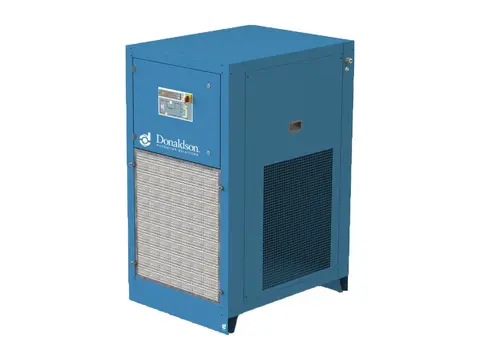
A refrigerated air dryer works quietly in the background. It cools your compressed air until the water in it condenses, drains that water away and sends dry air on to your plant. When it starts to struggle, nothing announces it. The dew point creeps up, and the first sign is often water at a machine, rust in a filter bowl or a rejected batch.
A dryer that loses its refrigeration can pass air saturated at 35 °C, carrying about 5.3 kg of water per hour for every 1,000 m³/h of free air. The checks below catch the causes long before that happens. Most take a few minutes.
Check the automatic drain every day
The drain is the part most likely to let you down. Scale and oil sludge block its inlet strainer and valve seat. A blocked drain floods the separator and puts the water straight back into your air, while a drain stuck open vents compressed air all day.
Press the manual test button daily and make sure condensate discharges. Service the drain every 6–12 months, and clean its strainer at every service visit: rust particles and pipe scale collect there first, and a partly blocked strainer slows discharge until condensate backs up at peak load.
Read the gauges and keep a monthly log
Check the evaporator or suction pressure gauge monthly. The reading should correspond to an evaporating temperature just above 0 °C. What it tells you when it doesn’t:
- A low reading points to refrigerant loss or icing.
- A high reading points to condenser fouling, a high inlet load or a faulty bypass valve.
Once a month, write down four numbers: dew point, dryer pressure drop, refrigerant pressure and ambient temperature. Trends in that log reveal condenser fouling, refrigerant loss and drain wear before any of them causes a quality failure.
Keep the condenser clean and breathing
Clean the condenser fins every 3–6 months, and more often in dusty rooms. Dust on the fins restricts the cooling air and raises condensing pressure. The refrigerant compressor then draws more power, the outlet dew point rises, and on hot days the high-pressure switch stops the dryer and sends saturated air downstream.
Keep the condenser inlet grille clear of stored materials and dust, and verify the condenser fan and cooling air path every 6 months. A failed fan or blocked grille causes rapid high-pressure trips. On water-cooled units, check water flow and strainers too, because scale in the condenser has the same effect.
Once a year: filters, heat exchangers and dew point
- Replace the filter elements upstream and downstream, every 12 months or at the differential pressure limit. Every extra bar your compressor adds to push air through a loaded element costs about 7 % more energy, and a saturated pre-filter passes oil that coats the heat exchanger surfaces and reduces cooling.
- Inspect the heat exchangers for oil fouling and check their pressure drop. A rising pressure drop at unchanged flow means fouling that reduces heat transfer and raises compressor discharge pressure.
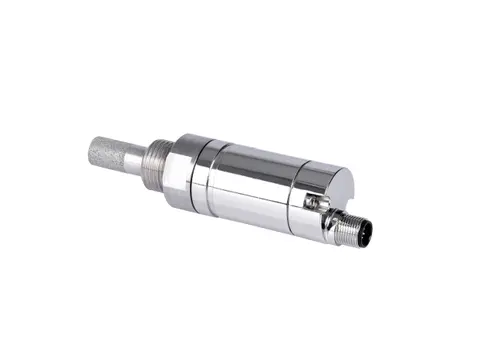
- Measure the outlet pressure dew point with a calibrated hygrometer, at least annually. Gradual rises from condenser fouling, refrigerant loss or separator wear stay invisible until water appears at the point of use.
Check the refrigerant circuit for leaks
Check the circuit for leaks at the interval your applicable refrigerant regulations set. Refrigerant loss starves the evaporator and raises the dew point gradually, so a slow leak goes unnoticed without a check.
Signs that something is wrong
- Water at machines or in drip legs: the dew point has risen. Measure it, then work back through the condenser, refrigerant and drain.
- High-pressure trips on hot days: a fouled condenser, a failed fan or a blocked grille.
- A constant hiss from the drain: the drain is stuck open and venting compressed air.
- Pressure drop rising at the same flow: fouled heat exchangers or loaded filter elements.
Let our engineers take a look
Our dryer health testing measures what your dryer actually delivers under your plant’s real flow, pressure and temperature, and tells you whether it meets its rated pressure dew point. For routine care, our commissioning and service team looks after the dryer and everything around it: filters, drains, bypass valves and the dew point measurement point.